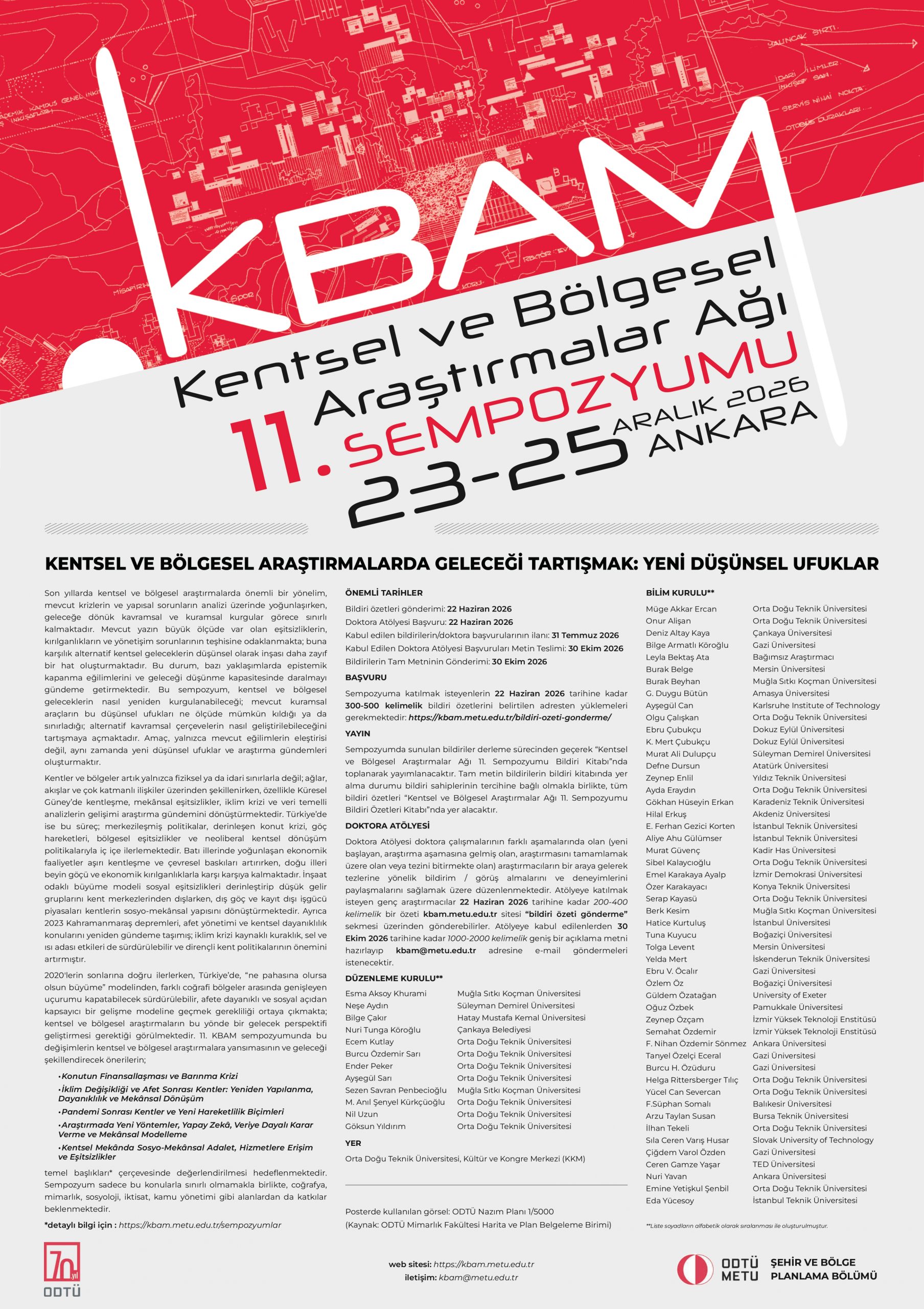
11th Urban And Regional Research Network Symposium
DISCUSSING THE FUTURE IN URBAN AND REGIONAL RESEARCH: NEW INTELLECTUAL HORIZONS
December 23-24-25, 2026 METU, Ankara
In recent years, a significant trend in urban and regional research has heavily focused on analyzing current crises and structural problems, while forward-looking conceptual and theoretical constructs have remained relatively limited. Current literature largely emphasizes diagnosing existing inequalities, vulnerabilities, and governance issues; conversely, the intellectual construction of alternative urban futures forms a much weaker line of inquiry. This situation brings to light tendencies of epistemic closure in certain approaches and a narrowing of the capacity to think about the future. This symposium opens a discussion on how urban and regional futures can be reconstructed; to what extent current theoretical tools enable or limit these intellectual horizons; and how alternative conceptual frameworks might be developed. The goal is not only to critique current trends but also to create new intellectual horizons and research agendas.
Leaving the first quarter of the 21st century behind, accelerating social, economic, environmental, and technological transformations require a reevaluation of urban and regional research. As cities become increasingly complex dynamic spaces where social, economic, technological, and cultural processes intersect, regions are no longer defined solely by administrative boundaries, but through networks, flows, and multi-layered relationships. This transformation makes it necessary to question both the theoretical frameworks and methods of urban and regional research and to develop new perspectives. Particularly in the Global South, accelerating urbanization, deepening socio-economic vulnerabilities, increasing spatial inequalities within and between regions, the impacts of the climate crisis, and advancements in data-driven analysis capabilities are simultaneously reshaping the research agenda and its tools.
During this period in Türkiye, urban and regional dynamics are being shaped within a context where centralized policies and decision-making processes, a deepening housing crisis, and the devastating impacts of natural disasters intertwine. At the regional scale, the “East-West” divide remains a persistent structural issue, while economic activities and skilled labor are still largely concentrated in western provinces. This concentration has created a migration cycle spanning decades; within this cycle, western provinces struggle with over-urbanization, infrastructural burdens, and environmental degradation, while eastern provinces face a brain drain and limited economic diversification.
Furthermore, driven by globalization dynamics, rapid technological change, and the transformation of production processes, migration is shifting to higher scales and evolving into a global circulation regime. The transnational mobility of highly skilled labor, in particular, has significantly increased. Consequently, both labor and production processes are increasingly situated in a multi-layered, network-based geography beyond national borders; decision-making, production, and value-creation processes are being fragmented and reorganized on a global scale.
Alongside this, a construction-oriented growth model has rapidly transformed the physical structure of metropolises while triggering a neoliberal “urban transformation” process that prioritizes land commodification over social equality. This has led to the transformation of squatter (gecekondu) neighborhoods, the exclusion of low-income groups from city centers, and mounting difficulties in accessing housing. Surging inflation and economic vulnerabilities have further deepened this shelter crisis. Additionally, external migration exacerbated by regional conflicts has significantly altered the socio-spatial structure of many cities, burdening local services and creating new informal labor markets and ethnic enclaves that urban planning institutions frequently struggle to integrate.
A defining urban crisis of recent years occurred with the Kahramanmaraş earthquakes in February 2023. This disaster made it imperative to rethink urban resilience and disaster management. In the context of the climate crisis, escalating urban heat island effects, droughts, and floods are making the multi-layered risks cities face far more visible. As Türkiye prepares to host COP31, there is a push for zero-waste initiatives and climate-adapted infrastructure; however, in areas where the pressure for rapid economic growth overrides long-term ecological sustainability, implementing these policies on the ground remains highly challenging.
As we approach the late 2020s, the necessity of shifting away from a “growth at all costs” model in Türkiye toward a sustainable, disaster-resilient, and socially inclusive development model capable of bridging the widening geographical gap has become apparent. Urban and regional research must develop a future-oriented perspective in this direction. The 11th KBAM (Urban and Regional Research Network) Symposium aims to evaluate how these changes reflect on urban and regional research and to discuss proposals that will shape the future within the framework of the main themes below. While the symposium is not limited strictly to these topics, contributions are highly encouraged from fields such as geography, architecture, sociology, economics, and public administration.
The Financialization of Housing and the Shelter Crisis
Housing is not merely a physical shelter unit; it is an element positioned at the very center of social justice, accessibility, and urban rights. The transformation of real estate into an investment vehicle on a global scale is deepening the “affordable housing” crisis worldwide. When discussing the future, the symposium aims to address neighborhood structures under transformation pressure, changing household compositions, the resulting housing needs, alternative solutions against the financialization of housing, and accessible housing production models.
Climate Change and Post-Disaster Cities: Reconstruction, Resilience, and Spatial Transformation
In recent years, increasing natural disasters—particularly earthquakes—have had profound impacts on the physical, social, and institutional structures of cities, reshaping urban planning approaches. Post-disaster reconstruction processes encompass not only the physical rebuilding of spaces but also temporary and permanent shelter solutions, safe transportation networks, and social solidarity mechanisms. In this context, it is crucial to develop holistic approaches that strengthen risk reduction, mitigation planning, and social resilience to build resilient cities. The relationship between pre- and post-disaster processes and spatial justice, the protection of vulnerable groups, and long-term urban transformation policies are among the core topics expected to be discussed.
Post-Pandemic Cities and New Forms of Mobility
The COVID-19 pandemic prompted a rethinking of living, working, and mobility patterns in cities. In this context, the “15-Minute City” approach, the integration of work and living spaces, pedestrian-prioritized planning, and decentralization trends lie at the heart of these discussions. Furthermore, with the widespread adoption of remote work, smaller cities and settlements located near metropolises or with easy access to them have gained prominence. The local and regional impacts of these shifts are also vital topics for debate.
New Methods in Research, Artificial Intelligence, Data-Driven Decision Making, and Spatial Modeling
Ongoing social transformations, crises, and technological advancements compel researchers to rethink the methodologies used in urban and regional studies. New approaches that transcend classical data collection and analysis techniques are being explored alongside big data, open data, citizen science, data ethics, behavioral analysis, and ecological perspectives. In this process, data-driven decision-making mechanisms and policy development strengthen not only the analytical but also the applied dimension of research. Spatial modeling, spatial statistics, and AI-based analyses provide essential tools for understanding complex urban processes and developing future-oriented scenarios. Interdisciplinary, innovative, and applicable methodological studies incorporating data-driven decision support systems are expected under this theme.
Socio-Spatial Justice, Access to Services, and Inequalities in Urban Space
Cities are increasingly defined as spaces where distinct social groups are spatially segregated and access to resources and services is unequally distributed. While spatial segregation, migration, and ethnic spatialization deepen disparities in accessing urban services, access to education, healthcare, green spaces, and public areas remains a fundamental determinant of social justice. In this context, the urban environment’s impact on health, spatial health inequities, and the position of vulnerable groups (children, the elderly, immigrants, etc.) within the city constitute a critical research area. The distribution, accessibility, and quality of urban services depend not just on physical infrastructure but also on governance, planning policies, and social inclusion mechanisms. Papers are expected to explore how inclusive planning approaches and multi-scalar governance models can be developed to reduce inequalities and ensure socio-spatial justice.
IMPORTANT DATES
Symposium Announcement: May 22, 2026
Abstract Submission Deadline: June 22, 2026
Doctoral Workshop Application Deadline: June 22, 2026
Announcement of Accepted Papers/Doctoral Applications: July 31, 2026
Submission of Full Papers for Accepted Doctoral Workshop Applications: October 30, 2026
Submission of Full Paper Texts: October 30, 2026
APPLICATION
Those who wish to participate in the symposium must upload their 300-500 word abstracts to https://kbam.metu.edu.tr/bildiri-ozeti-gonderme/ by June 22, 2026.
PUBLICATION
Papers presented at the symposium will undergo a review process and be published in the “Urban and Regional Research Network 11th Symposium Proceedings Book”. While inclusion in the full proceedings book is optional and based on the authors’ preference, all accepted abstracts will be published in the “Urban and Regional Research Network 11th Symposium Book of Abstracts”.
DOCTORAL WORKSHOP
The Doctoral Workshop is organized to bring together researchers at various stages of their PhD studies (beginners, those in the research phase, those nearing completion, or finalizing their thesis) to receive feedback, exchange ideas, and share experiences regarding their work. Young researchers wishing to participate must submit a 200-400 word abstract via the “bildiri özeti gönderme” (submit abstract) tab on kbam.metu.edu.tr by June 22, 2026. Those accepted into the workshop will be required to prepare an extended explanatory text of 1000-2000 words by October 30, 2026, and email it to kbam@metu.edu.tr.
11th SYMPOSIUM ORGANIZING COMMITTEE*
Esma Aksoy Khurami Muğla Sıtkı Koçman Üniversitesi
Neşe Aydın Süleyman Demirel Üniversitesi
Bilge Çakır Hatay Mustafa Kemal Üniversitesi
Nuri Tunga Köroğlu Çankaya Belediyesi
Ecem Kutlay Orta Doğu Teknik Üniversitesi
Burcu Özdemir Sarı Orta Doğu Teknik Üniversitesi
Ender Peker Orta Doğu Teknik Üniversitesi
Ayşegül Sarı Orta Doğu Teknik Üniversitesi
Sezen Savran Penbecioğlu Muğla Sıtkı Koçman Üniversitesi
Anıl Şenyel Kürkçüoğlu Orta Doğu Teknik Üniversitesi
Nil Uzun Orta Doğu Teknik Üniversitesi
Göksun Yıldırım Orta Doğu Teknik Üniversitesi
*The list has been organized in alphabetical order by surname.
11th SYMPOSIUM SCIENTIFIC COMMITTEE*
Müge Akkar Ercan Orta Doğu Teknik Üniversitesi
Onur Alişan Orta Doğu Teknik Üniversitesi
Deniz Altay Kaya Çankaya Üniversitesi
Bilge Armatlı Köroğlu Gazi Üniversitesi
Leyla Bektaş Ata Bağımsız Araştırmacı
Burak Belge Mersin Üniversitesi
Burak Beyhan Muğla Sıtkı Koçman Üniversitesi
Duygu Bütün Amasya Üniversitesi
Ayşegül Can Karlsruhe Institute of Technology
Olgu Çalışkan Orta Doğu Teknik Üniversitesi
Ebru Çubukçu Dokuz Eylül Üniversitesi
Mert Çubukçu Dokuz Eylül Üniversitesi
Murat Ali Dulupçu Süleyman Demirel Üniversitesi
Defne Dursun Atatürk Üniversitesi
Zeynep Enlil Yıldız Teknik Üniversitesi
Ayda Eraydın Orta Doğu Teknik Üniversitesi
Gökhan Hüseyin Erkan Karadeniz Teknik Üniversitesi
Hilal Erkuş Akdeniz Üniversitesi
Ferhan Gezici Korten İstanbul Teknik Üniversitesi
Aliye Ahu Gülümser İstanbul Teknik Üniversitesi
Murat Güvenç Kadir Has Üniversitesi
Sibel Kalaycıoğlu Orta Doğu Teknik Üniversitesi
Emel Karakaya Ayalp İzmir Demokrasi Üniversitesi
Özer Karakayacı Konya Teknik Üniversitesi
Serap Kayasü Orta Doğu Teknik Üniversitesi
Berk Kesim Muğla Sıtkı Koçman Üniversitesi
Hatice Kurtuluş İstanbul Üniversitesi
Tuna Kuyucu Boğaziçi Üniversitesi
Tolga Levent Mersin Üniversitesi
Yelda Mert İskenderun Teknik Üniversitesi
Ebru V. Öcalır Gazi Üniversitesi
Özlem Öz Boğaziçi Üniversitesi
Güldem Özatağan University of Exeter
Oğuz Özbek Pamukkale Üniversitesi
Zeynep Özçam İzmir Yüksek Teknoloji Enstitüsü
Semahat Özdemir İzmir Yüksek Teknoloji Enstitüsü
Nihan Özdemir Sönmez Ankara Üniversitesi
Tanyel Özelçi Eceral Gazi Üniversitesi
Burcu H. Özüduru Gazi Üniversitesi
Helga Rittersberger Tılıç Orta Doğu Teknik Üniversitesi
Yücel Can Severcan Orta Doğu Teknik Üniversitesi
F.Süphan Somalı Balıkesir Üniversitesi
Arzu Taylan Susan Bursa Teknik Üniversitesi
İlhan Tekeli Orta Doğu Teknik Üniversitesi
Sıla Ceren Varış Husar Slovak University of Technology
Çiğdem Varol Özden Gazi Üniversitesi
Ceren Gamze Yaşar TED Üniversitesi
Nuri Yavan Ankara Üniversitesi
Emine Yetişkul Şenbil Orta Doğu Teknik Üniversitesi
Eda Yücesoy İstanbul Teknik Üniversitesi
*The list has been organized in alphabetical order by surname.